Contents
- P.1 Real Numbers and the Real Line
- Quiz 1: Real Numbers, Inequalities and Absolute Value
- P.2 Cartesian Coordinates in the Plane
- P.3 Graphs of Quadratic Equations
- Quiz 2: Coordinates, Lines and Graphs
- P.4 Functions and Their Graphs
- P.5 Combining Functions
- P.6 Polynomials and Rational Functions
- Quiz 3: Functions and Polynomials
- P.7 Trigonometric Functions
- Exponential and Logarithmic Functions
- Inverse Functions
- Quiz 4: Trigonometric, Exponential, Logarithmic and Inverse Functions
- Limits
- Quiz 5: Limits
- Continuity
- Quiz 6: Limit Techniques and Continuity
- Flashcards
AP Calculus: Lecture Notes
These are the notes of my AP Calculus lectures. The course runs in this order:
For the preliminaries we follow the preliminary chapter of Adams & Essex, Calculus: A Complete Course (sections P.1–P.7), together with exponential, logarithmic and inverse functions from its Chapter 3. From limits on we follow Barron's AP Calculus. The examples are the ones we worked through on the board. After each part there is a quiz of 15 multiple-choice questions, in the style of the AP exam.
| Part | Topic | Status |
|---|---|---|
| P.1 | Real numbers, inequalities, absolute value | covered |
| P.2–P.3 | Coordinates, lines, circles, parabolas, ellipses | covered |
| P.4–P.6 | Functions, combining functions, polynomials | covered |
| P.7 | Trigonometric functions | covered |
| 3.1–3.5 | Exponential, logarithmic and inverse functions | covered |
| Unit 1 | Limits and continuity | covered |
| Units 2–10 | Derivatives, integrals, differential equations, series | coming later |
P.1 Real Numbers and the Real Line
Number Systems
- Natural numbers: (some books start at ).
- Integers: .
- Rational numbers: .
The rational numbers are dense, but they have gaps. Split into two sets: , the rationals that are negative or have , and , the positive rationals with . Then and , but there is no rational number at the place where ends and begins: that place is , which is not rational.

Definition. The real numbers are the smallest number system that contains and has no gaps. A real number that is not rational is called irrational.
Proposition. is not a rational number.
Proof. Suppose, on the contrary, that with , , and that and have no common divisor (we can always cancel the fraction). Then Write . Then , so , and is even too. Now and are both even, so is a common divisor: a contradiction. Therefore no such and exist.
Decimal Expansions
Every real number has a decimal expansion. Every irrational number has an infinite decimal expansion, but not every infinite decimal is irrational: a decimal that repeats is always rational.
Example. Write as a fraction. Multiply by , since the block has three digits:
Order in the Real Numbers
means , and means . The rules for working with inequalities:
- If , then for every real . (Adding or subtracting a number keeps the direction.)
- If and , then . If and , then : multiplying by a negative number reverses the inequality. For example , but .
- If , then .
- If , then .
Intervals
| Notation | Set | Name |
|---|---|---|
| open interval | ||
| closed interval | ||
| , | , | half-open (half-closed) interval |
| , | , | infinite intervals |
| all of | the real line |
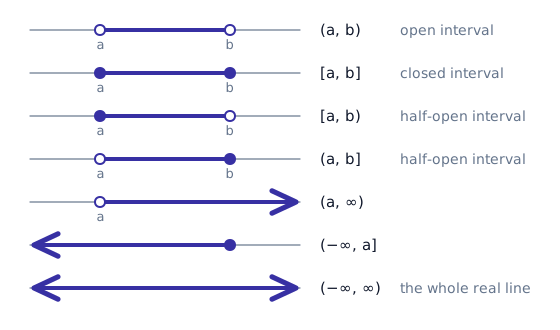
is not a number, so it never gets a square bracket.
Solving Inequalities
Example (a). . Subtract , then : . Solution: .
Example (b). . Multiply by (reverse!): , so and . Solution: .
Example (c). . We cannot just multiply by , because its sign is unknown. Two cases:
- : then , so and . Together with : .
- : then the inequality reverses, , so . This contradicts : no solution.
Solution: .
Another solution. Bring everything to one side: A quotient is positive when numerator and denominator have the same sign. and gives ; and has no solution.
Example (d). . Solve both parts: Both must hold: .
Quadratic Inequalities
A quadratic is a polynomial of degree two, with .
Example. . Factor: . A product is negative when the two factors have opposite signs:
- and : and , no solution.
- and : .
Solution: .
A general method. To find the roots of we use the discriminant
| Roots | |
|---|---|
| two different real roots | |
| one double root: | |
| no real roots |
Examples.
- : , , , , so and .
- : , so : , . Indeed .
- : , one double root ; indeed .
Proof of the Quadratic Formula
Motivation: . This lets us complete the square:
Proof (of the quadratic formula). Divide by and complete the square: Taking square roots,
Sign Charts
If has two roots , it has the sign of outside the roots and the opposite sign between them: for the signs are , for they are .
The same idea works for any polynomial whose roots we know: mark the roots on a line and find the sign on each piece. The sign changes at a root of odd multiplicity and does not change at a root of even multiplicity.
Example. . The roots are , (triple) and (double). For large everything is positive, so going from right to left the signs are (after 2), (no change at the double root 2), (change at 1), (change at ).
- : .
- : .
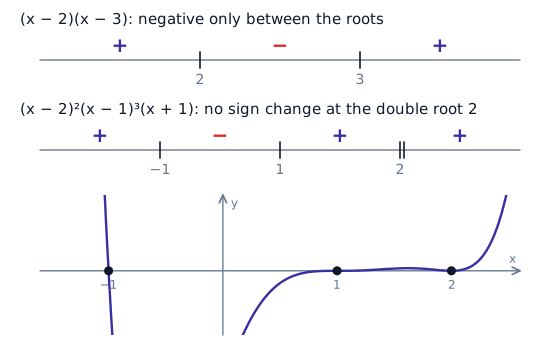
Example. . Roots of the numerator: (double) and (triple); is not allowed. The signs, from the left: , (no change at ), , (no change at ).
- : .
- : .
The Absolute Value
Definition. The absolute value of is
is the distance from to on the real line; for example . More generally, is the distance between and .
Equations and inequalities with . For :
| means | solution | |
|---|---|---|
| or | two points | |
| or |
The same with and , endpoints included. Replacing by :
Examples.
- : or .
- : . : .
- : or , so or : the two points at distance from .
- : , so : .
- : or : .
- only for .
Properties.
- ; for example and .
- ; for example .
- for .
Exercise (41). Solve .
Solution. Split the line at and , where the expressions inside change sign.
- : , always true. All work.
- : . This gives .
- : , never true.
Solution: . As a statement about distances: is closer to than to , which means is to the right of the midpoint .
Quiz 1: Real Numbers, Inequalities and Absolute Value
15 multiple-choice questions on P.1. No calculator. Suggested time: 30 minutes.
1. Which of the following numbers is irrational?
- (A)
- (B)
- (C)
- (D)
2. Which fraction in lowest terms is equal to ?
- (A)
- (B)
- (C)
- (D)
3. If and , which of the following must be true?
- (A)
- (B)
- (C)
- (D)
4. What is the solution set of ?
- (A)
- (B)
- (C)
- (D)
5. What is the solution set of ?
- (A)
- (B)
- (C)
- (D)
6. What is the solution set of ?
- (A)
- (B)
- (C)
- (D)
7. What are the roots of ?
- (A) and
- (B) and
- (C) and
- (D) and
8. For which value of does have exactly one (double) real root?
- (A)
- (B)
- (C)
- (D)
9. What is the solution set of ?
- (A)
- (B)
- (C)
- (D)
10. What are the solutions of ?
- (A) only
- (B) or
- (C) or
- (D) There is no solution.
11. What is the solution set of ?
- (A)
- (B)
- (C)
- (D)
12. What is the solution set of ?
- (A)
- (B)
- (C)
- (D)
13. Which inequality describes the open interval ?
- (A)
- (B)
- (C)
- (D)
14. What is the solution set of ?
- (A)
- (B)
- (C)
- (D)
15. Which statement is true for all real numbers and ?
- (A)
- (B)
- (C)
- (D)
Answer key
| Question | Answer | Why |
|---|---|---|
| 1 | C | A repeating decimal and are rational, and . |
| 2 | B | . |
| 3 | C | Multiplying by a negative number reverses the inequality. |
| 4 | A | ; dividing by reverses it: . |
| 5 | D | ; is not allowed, is. |
| 6 | A | : negative between the roots. |
| 7 | D | , ; or . |
| 8 | C | . |
| 9 | B | No sign change at the double root : signs . |
| 10 | C | or . |
| 11 | A | . |
| 12 | D | or . |
| 13 | C | Centre , half-length ; open interval, so a strict inequality. |
| 14 | B | is closer to than to : to the right of the midpoint . |
| 15 | B | The others fail for , (A, D) or (C). |
P.2 Cartesian Coordinates in the Plane
The two axes divide the plane into four quadrants, numbered I to IV counterclockwise starting from the upper right. The point is units along the -axis and units along the -axis.
The Distance Formula
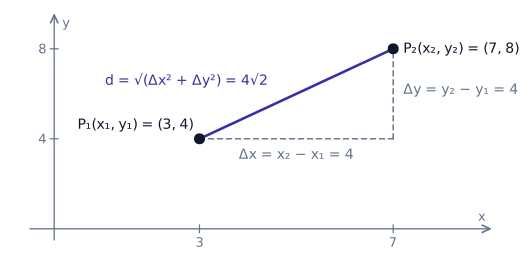
The distance between and is the hypotenuse of a right triangle with legs and , so by Pythagoras
Example. , : .
The Equation of a Circle
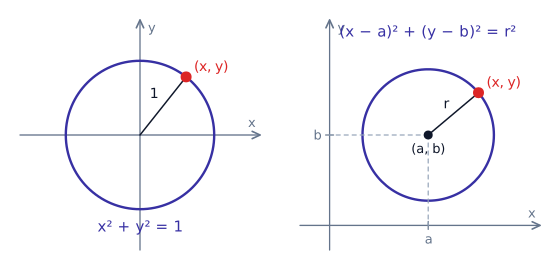
A point is on the circle with centre and radius exactly when its distance to the centre is : In general, the circle with centre and radius is
Examples.
- is the circle with centre and radius .
- . Complete the squares: , so : the circle with centre and radius .
The Equation of a Parabola
is the basic parabola, with its vertex at the origin. Moving the vertex to gives
Example. , so : a parabola with vertex .
Straight Lines
The slope of a line is where is the angle the line makes with the positive -axis. A line rising units for every unit to the right has ; a line falling unit for every unit has .
Point-slope form. If the line has slope and passes through , then for any other point on it
Example. Through with slope : , so .
Two-point form. Through and : first the slope , then the point-slope form with either point. Both points give the same equation.
Example. Through and : . With : , so . With : , again .
Perpendicular lines. Two lines with slopes and are perpendicular when
Example. The line through perpendicular to . Here , so and , that is, .
Intercepts. The -intercept is where the line meets the -axis (put ); the -intercept is where it meets the -axis (put ). For : gives , and gives . So the line passes through and .
Intercept form. The line with -intercept and -intercept (through and ) is
P.3 Graphs of Quadratic Equations
Circles and Disks
The circle has centre and radius . An equality describes a curve, an inequality describes a region:
- is only the point .
- is the circle of radius .
- , that is, , is the closed disk of radius : the circle together with its inside.
- is the open disk (the inside only).
On the circle lie, for example, , , and .
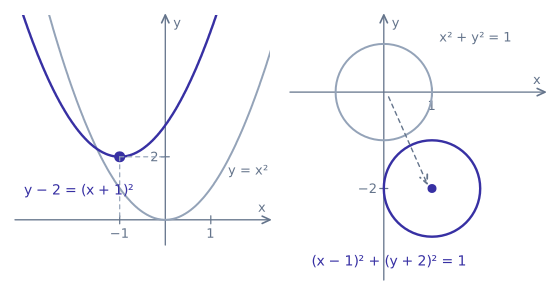
Shifting a Graph
| Replace | by | The graph moves |
|---|---|---|
| () | units to the right | |
| () | units to the left | |
| () | units up | |
| () | units down |
Examples.
- : one unit to the right. : then two units down.
- : three units to the right.
- : one unit to the left and two units up; the vertex moves to .
Scaling a Graph
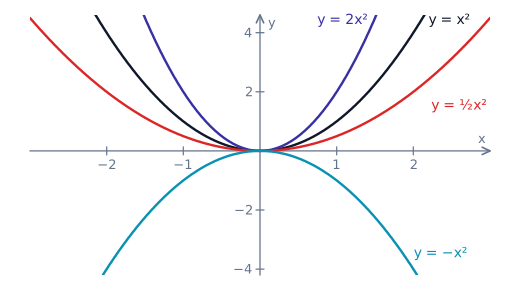
Multiplying the function by a number stretches or squeezes the graph vertically: is narrower than , is wider, and is reflected in the -axis.
Ellipses
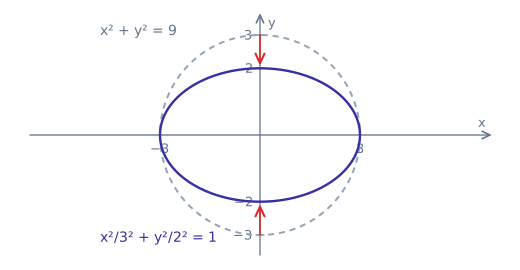
We can write the equation of a circle as Changing one of the two denominators squeezes the circle into an ellipse: still meets the -axis at , but meets the -axis at . In general, is the ellipse through and .
Quiz 2: Coordinates, Lines and Graphs
15 multiple-choice questions on P.2 and P.3. No calculator. Suggested time: 30 minutes.
1. What is the distance between and ?
- (A)
- (B)
- (C)
- (D)
2. What are the centre and the radius of the circle ?
- (A) centre , radius
- (B) centre , radius
- (C) centre , radius
- (D) centre , radius
3. Which is the equation of the circle with centre that passes through the origin?
- (A)
- (B)
- (C)
- (D)
4. What is the slope of the line through and ?
- (A)
- (B)
- (C)
- (D)
5. Which is the line through with slope ?
- (A)
- (B)
- (C)
- (D)
6. Which line passes through and is perpendicular to ?
- (A)
- (B)
- (C)
- (D)
7. A line makes an angle of with the positive -axis. What is its slope?
- (A)
- (B)
- (C)
- (D)
8. What are the intercepts of the line ?
- (A) -intercept , -intercept
- (B) -intercept , -intercept
- (C) -intercept , -intercept
- (D) -intercept , -intercept
9. Which is the line with -intercept and -intercept ?
- (A)
- (B)
- (C)
- (D)
10. What is the vertex of the parabola ?
- (A)
- (B)
- (C)
- (D)
11. How is the graph of obtained from the graph of ?
- (A) 3 units right and 1 unit down
- (B) 3 units left and 1 unit up
- (C) 3 units left and 1 unit down
- (D) 3 units right and 1 unit up
12. The circle is the unit circle moved
- (A) 1 unit right and 2 units down.
- (B) 1 unit left and 2 units up.
- (C) 1 unit right and 2 units up.
- (D) 1 unit left and 2 units down.
13. Compared with the graph of , the graph of is
- (A) narrower and opens upward.
- (B) narrower and opens downward.
- (C) wider and opens upward.
- (D) wider and opens downward.
14. Where does the ellipse meet the axes?
- (A) and
- (B) and
- (C) and
- (D) and
15. Which set does describe?
- (A) only the circle of radius
- (B) the disk of radius
- (C) the circle of radius together with its inside
- (D) the points outside the circle of radius
Answer key
| Question | Answer | Why |
|---|---|---|
| 1 | B | . |
| 2 | C | . |
| 3 | A | . |
| 4 | D | . |
| 5 | B | . |
| 6 | C | Slope : . |
| 7 | A | . |
| 8 | D | gives ; gives . |
| 9 | A | ; multiply by . |
| 10 | B | . |
| 11 | C | moves left, moves down. |
| 12 | A | : right; : down. |
| 13 | D | A factor smaller than widens; the minus sign flips. |
| 14 | B | , . |
| 15 | C | An inequality gives a region: the closed disk of radius . |
P.4 Functions and Their Graphs
Definition of a Function
Definition. A function on a set into a set is a rule that assigns a unique element in to each element in . The set is the domain of , written ; the set of all values is the range of , written .
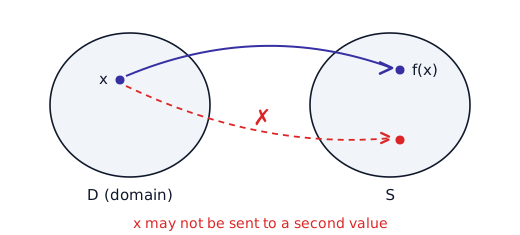
Think of a function as a machine: goes in (from the domain), comes out (into the range). In calculus we study functions on numbers, mostly on the real numbers .
Examples of functions.
- : a constant function. Its graph is the horizontal line .
- .
- is not a function of : for we get both and .
- Motion along a line: the position at time is . Its velocity is and its acceleration is (we will see why when we study derivatives).
- The area of a rectangle with sides and : .
- The volume of a cone of height and base radius : .
The Vertical Line Test
Theorem (Vertical line test). A curve in the plane is the graph of a function if and only if every vertical line meets it at most once.
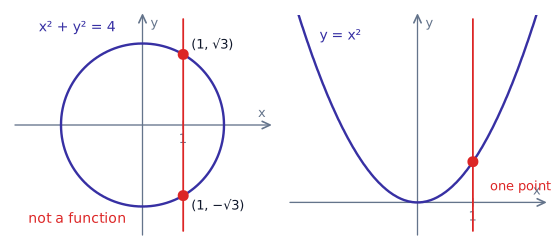
The Domain Convention
Definition (The domain convention). When a function is given only by its rule, without its domain, we take as its domain the set of all real numbers for which is a real number. This is the maximal domain of .
Two functions are equal if (1) their rules are the same and (2) their domains are the same. For example, are different functions: the graph of is only the right half of the parabola.
Finding the maximal domain of a function is tested on the AP exam. Watch out for square roots (the inside must be ) and denominators (they must be ).
- : .
- : .
Graphs of Basic Functions
You should know these graphs by heart; most of the functions in the course are built from them.
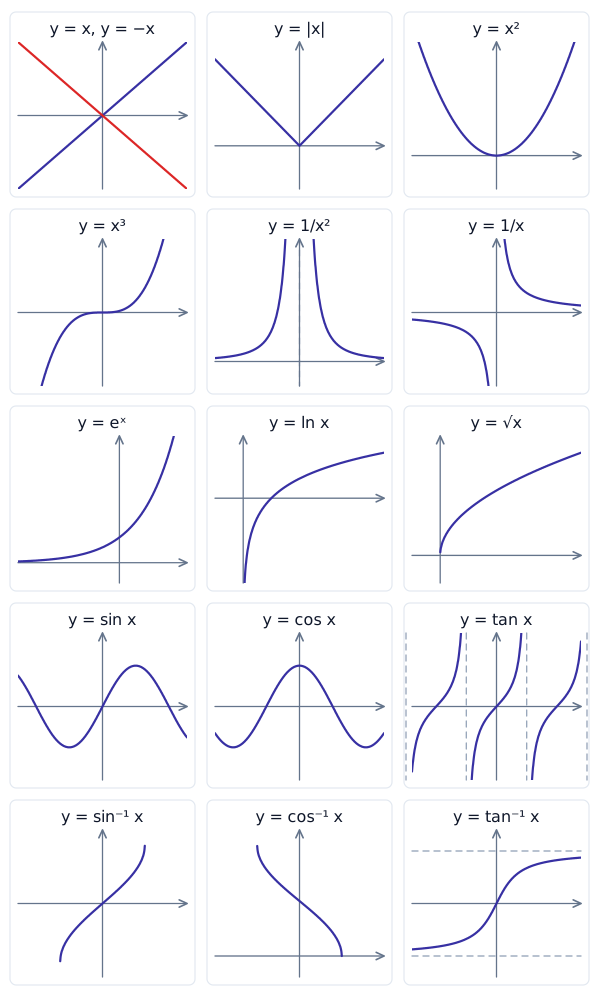
- looks like every even power , and like every odd power (flatter near , steeper far away).
- looks like , and like .
- The graph of is the lower half of the unit circle, and the upper half.
P.5 Combining Functions
Sums, Differences, Products and Quotients
Definition. If and are functions, then for every in the domains of both and :
Example. , : and at , so .
Recall: the domain (tanım kümesi) is the set of inputs we may use; the range (değer kümesi) is the set of values the function actually takes.
- : domain , range .
- : domain , range .
- : domain , range .
Exercise. For and , find formulas for , , , , and , and their domains.
Solution. and , so all combinations live on at most.
| Function | Formula | Domain |
|---|---|---|
In we remove , where ; in we remove , where .
Composite Functions
Definition. If and are functions, the composite function (bileşke fonksiyon) is defined by Its domain consists of the numbers in the domain of for which is in the domain of . In particular, if the range of is contained in the domain of , then .
Example. , :
| Function | Formula | Domain |
|---|---|---|
is defined for all , but is in the domain of only if , that is, . Note that in general.
Piecewise Defined Functions
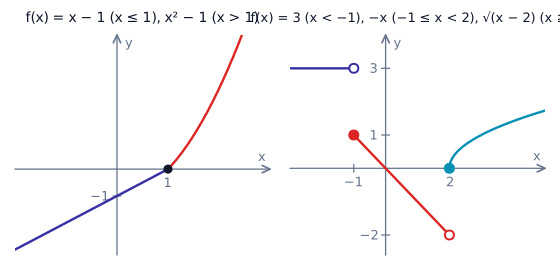
Sometimes a function is given by different formulas on different parts of its domain. The absolute value is one example:
Example. Then and .
Example.
P.6 Polynomials and Rational Functions
Polynomials
Definition. A polynomial is a function whose value at is where are constants, called the coefficients, and if . The number is the degree of . (The degree of the zero polynomial is not defined.)
Examples. has degree ; and have degree ; has degree .
Definition. If and are polynomials and is not the zero polynomial, then is a rational function. By the domain convention, its domain is all with .
Division of Polynomials
Polynomials can be divided like numbers, with a quotient and a remainder of lower degree than the divisor.
Example. Divide by . At each step, divide the leading term by and subtract:
- :
- : .
- has lower degree than , so we stop.
So the quotient is and the remainder is : Writing a rational function this way will be useful later, for limits at infinity and for integration.
Roots, Zeros and Factors
Definition. A number is a root (or zero) of the polynomial if .
Examples. has the root , since . has the root (and also and ).
Theorem (The factor theorem). The number is a root of the polynomial of degree at least if and only if is a factor of , that is, for some polynomial .
If is a factor of but is not, is a root of multiplicity .
Example. has the roots with multiplicities .
How to Find Roots
- Degree 1: gives .
- Degree 2: , with :
- : two real roots ;
- : one real root of multiplicity ;
- : no real roots.
- Degree 3 and higher: there are formulas for degrees 3 and 4, but we do not use them. (The discriminant of the cubic is ; it tells the nature of the roots.) Instead, try small integers ; once a root is found, divide by and continue with a polynomial of lower degree.
Examples.
- : , , and .
- If the roots are rational, we may find them by factoring: , roots and ; , roots and .
- : , no real roots.
- : , so : , . Indeed .
- . Try : , so is a factor. Dividing, , and the roots are .
Exercise. Find the roots of .
Solution. , so .
Factorization Rules
- . For example . This works not only for polynomials: , so .
- .
- In general,
- ; for odd , also .
The Binomial Expansion
For example and . In general where is the number of combinations of things taken at a time: The coefficients can also be read off Pascal's triangle, where each number is the sum of the two above it:
Example.
Quiz 3: Functions and Polynomials
15 multiple-choice questions on P.4–P.6. No calculator. Suggested time: 30 minutes.
1. Which of the following is not the graph of a function of ?
- (A)
- (B)
- (C)
- (D)
2. What is the domain of ?
- (A)
- (B)
- (C)
- (D)
3. What is the domain of ?
- (A)
- (B)
- (C)
- (D)
4. What is the domain of ?
- (A)
- (B)
- (C)
- (D)
5. What is the range of ?
- (A)
- (B)
- (C)
- (D)
6. Let and . What is the domain of ?
- (A)
- (B)
- (C)
- (D)
7. Let and . What are and its domain?
- (A) , domain
- (B) , domain
- (C) , domain
- (D) , domain
8. Let and . What is ?
- (A)
- (B)
- (C)
- (D)
9. Which pair consists of two equal functions (each with its maximal domain)?
- (A) and
- (B) and
- (C) and
- (D) and
10. Let What is ?
- (A)
- (B)
- (C)
- (D)
11. What is the degree of ?
- (A)
- (B)
- (C)
- (D)
12. What are the quotient and the remainder when is divided by ?
- (A) quotient , remainder
- (B) quotient , remainder
- (C) quotient , remainder
- (D) quotient , remainder
13. Which statement about is true?
- (A) is not a root.
- (B) is a root of multiplicity .
- (C) is a root of multiplicity .
- (D) is a root of multiplicity .
14. is a root of . What is its complete factorization?
- (A)
- (B)
- (C)
- (D)
15. What is the coefficient of in ?
- (A)
- (B)
- (C)
- (D)
Answer key
| Question | Answer | Why |
|---|---|---|
| 1 | B | The vertical line meets the circle twice. |
| 2 | C | . |
| 3 | A | Only the zero of the denominator, , is removed. |
| 4 | A | ; it must be positive, not zero, because it is in the denominator. |
| 5 | D | , so , and is reached at . |
| 6 | B | and ; is already excluded. |
| 7 | C | needs . |
| 8 | B | and . |
| 9 | C | Same rule and both domains are ; in the others the domains differ. |
| 10 | A | and . |
| 11 | C | The leading term is . |
| 12 | A | ; the rest is . |
| 13 | D | The exponent of is . |
| 14 | B | Divide by : . |
| 15 | D | . |
P.7 Trigonometric Functions
Trigonometric Ratios
In a right triangle with an acute angle :
Special Triangles
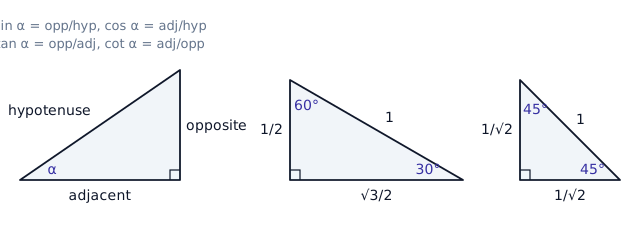
From these two triangles:
| undefined | |||||
| undefined |
If , then : the cosine of an angle is the sine of its complement.
Radians
radians, so For example , , , , . In calculus, angles are always in radians.
In physics, a velocity at angle has the components and .
The Unit Circle
Definition. Measure the angle (in radians) from the positive -axis, counterclockwise for positive and clockwise for negative . The point where it meets the unit circle is . This defines and for every real number , and
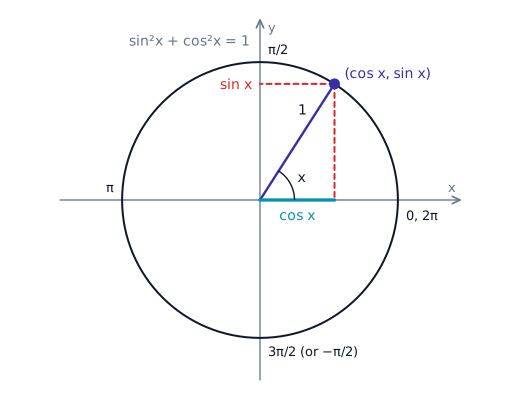
Since the point is on the unit circle, .
Examples.
- : the point at makes with the negative -axis, so it is . Thus and .
- : , so ends in the third quadrant at . Thus and .
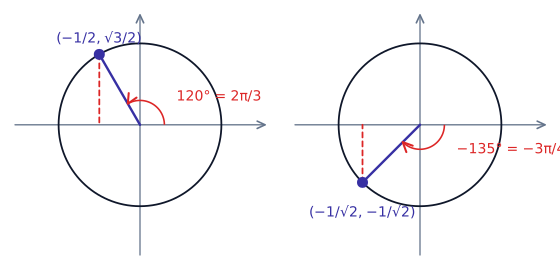
Exercise. Fill in and at , , , , .
Solution.
Important Trigonometric Identities
- If , then .
- : cosine is an even function. : sine is an odd function.
- .
- Addition formulas:
- Double-angle formulas:
- Half-angle formulas (from and , adding or subtracting):
- and : the range of both is , and the domain of both is .
Graphs of the Trigonometric Functions
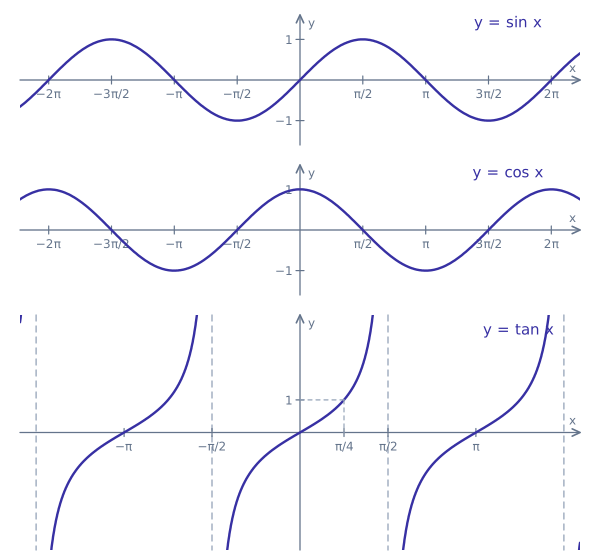
and are periodic with period . has period and is undefined where , at ; there its graph has vertical asymptotes.
The Sine and Cosine Laws
In a triangle with sides , , opposite the angles , , :
Exercise (7–12). Express in terms of and : (7) , (8) , (9) , (10) , (11) , (12) .
Solution. Use the unit circle or the addition formulas.
- (7) .
- (8) .
- (9) .
- (10) .
- (11) .
- (12) Multiply numerator and denominator by :
Exponential and Logarithmic Functions
Exponential Functions
Definition. If , then where is the number with .
For example . Irrational exponents are approximated by rational ones: approach ; in the same way makes sense. This is why we need : is not a real number.
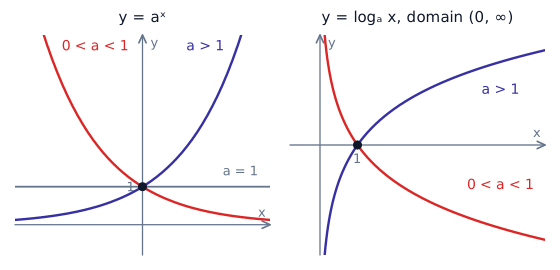
The exponential function with base is (), defined for all .
Theorem (Laws of exponents). If , and , are any real numbers, then
- ,
- ,
- ,
- ,
- ,
- .
The graph of always passes through . For it is increasing, for it is decreasing, and for it is the constant line . The larger is, the steeper the graph for .
Logarithmic Functions
Definition. For , , the logarithm is the number with : The function has domain .
For example because , and because .
Definition. The logarithm with base is the natural logarithm: .
, , . (Here and ; is a little more than .)
and are inverse functions of each other:
Theorem (Laws of logarithms). If , , , , and , then
- ,
- ,
- ,
- ,
- ; for example ,
- (change of base).
Some of these follow from the others:
- (3) follows from (5): .
- (4) follows from (2) and (3): .
By change of base, any logarithm can be computed with or :
Exercise (12). Simplify .
Solution. , so
Inverse Functions
One-to-One Functions
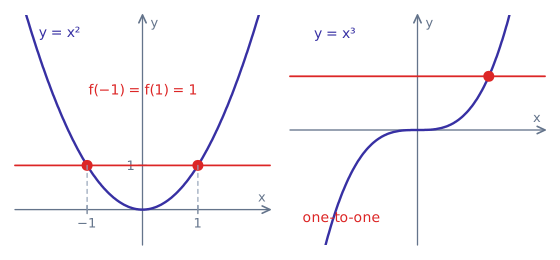
The function takes only one value for each , as every function does. But it also has a second property: different values of always give different values . Geometrically, every horizontal line meets its graph at most once.
Definition. A function is one-to-one if whenever and are in the domain of and ; equivalently, if
Theorem (Horizontal line test). A function is one-to-one if and only if every horizontal line meets its graph at most once.
Examples.
- is not one-to-one: but . From the definition: means , that is, , so or .
- is one-to-one: .
- is not one-to-one: horizontal lines between and meet its graph infinitely often.
The Inverse Function
Definition. If is one-to-one, it has an inverse function . The value is the unique number in the domain of for which :
Careful: is not .
How to find the inverse. Write and solve for .
Example. . From we get , so sends and ; sends them back: and .
For any inverse function, In the example: and .
Restricting the Domain to Get an Inverse
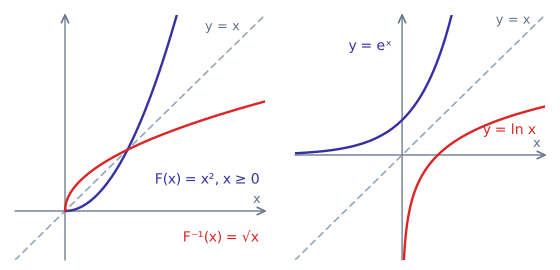
on has no inverse. But the function with domain (the right half of the parabola) is one-to-one, so it has an inverse: from , , we get , and . Note that , because their domains differ.
The graph of is the graph of reflected in the line . In the same way and are inverses of each other.
Inverse Trigonometric Functions
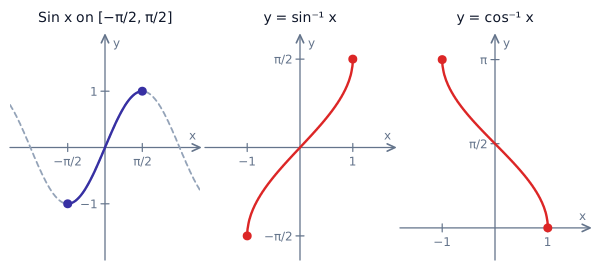
The inverse sine. is not one-to-one. We keep only the part of its graph on : there it takes every value between and exactly once. This restricted function is written .
Definition. The inverse sine function (or ) is the inverse of the restricted sine: Its domain is and its range is .
Examples.
- , because and is in .
- .
- and .
- is not defined: is not in the range of sine.
The inverse cosine. Similarly we restrict to .
Definition. The inverse cosine function is Its domain is and its range is .
Quiz 4: Trigonometric, Exponential, Logarithmic and Inverse Functions
15 multiple-choice questions on P.7 and on exponential, logarithmic and inverse functions. No calculator. Suggested time: 30 minutes.
1. What is in radians?
- (A)
- (B)
- (C)
- (D)
2. What is ?
- (A)
- (B)
- (C)
- (D)
3. What is ?
- (A)
- (B)
- (C)
- (D)
4. Which expression is equal to ?
- (A)
- (B)
- (C)
- (D)
5. Which expression is equal to ?
- (A)
- (B)
- (C)
- (D)
6. If and , what is ?
- (A)
- (B)
- (C)
- (D)
7. Which statement about is true?
- (A) Its domain is all real numbers.
- (B) Its range is .
- (C) Its period is .
- (D) Its graph has vertical asymptotes at .
8. What is ?
- (A)
- (B)
- (C)
- (D)
9. What is ?
- (A)
- (B)
- (C)
- (D)
10. What is the solution of ?
- (A) or
- (B)
- (C)
- (D)
11. Which expression is equal to ?
- (A)
- (B)
- (C)
- (D)
12. Which function is one-to-one on its maximal domain?
- (A)
- (B)
- (C)
- (D)
13. What is the inverse of ?
- (A)
- (B)
- (C)
- (D)
14. What is ?
- (A)
- (B)
- (C)
- (D)
15. What are the domain and the range of ?
- (A) domain , range
- (B) domain , range
- (C) domain , range
- (D) domain , range
Answer key
| Question | Answer | Why |
|---|---|---|
| 1 | A | . |
| 2 | C | The point at is . |
| 3 | B | The point at is in the third quadrant. |
| 4 | D | . |
| 5 | B | It equals . |
| 6 | C | , and cosine is negative in the second quadrant. |
| 7 | D | is undefined where ; its period is . |
| 8 | A | . |
| 9 | B | . |
| 10 | D | gives or , but is not defined. |
| 11 | B | , then . |
| 12 | C | forces ; the others take some value twice. |
| 13 | A | Solve for . |
| 14 | C | and is in . |
| 15 | D | Cosine is restricted to . |
Limits
Definition and First Examples
Definition (Informal definition of a limit). The number is the limit of as approaches if, as gets arbitrarily close to (but not equal to ), gets arbitrarily close to . We write
goes to but is never equal to : the value itself plays no role, and need not even be defined at .
One-sided limits. can approach from the left (through values less than ) or from the right (through values greater than ):
Theorem.
Example. .
Example. is not defined at . But for , A table confirms it: , , . Far from the values are different: , .
Example. In the graph below, , so does not exist.
The Greatest Integer Function
Definition. is the greatest integer less than or equal to .
For example , , . Its graph is a staircase (a step function). At every integer the left and right limits differ; for example
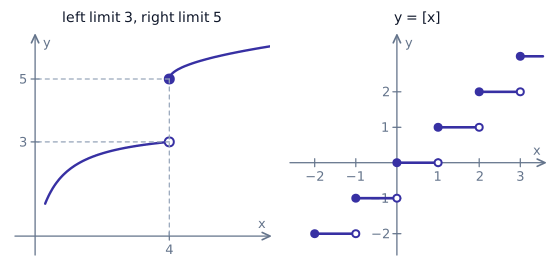
Constant functions. For the limit is always : . For example , , .
A Worked Example
Does have a limit at (a) , (b) , (c) , (d) ?
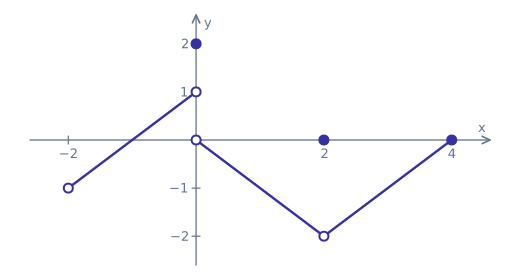
The domain is , and its boundary points are and . At a boundary point we check only the one-sided limit from inside the domain.
- (a) , so the limit exists and equals .
- (b) : the limit does not exist.
- (c) , so (although ).
- (d) is a boundary point: , so .
More Examples
Example. Prove that . The domain of is and Since the left and right limits are equal, .
Example. What is the domain of ? We need :
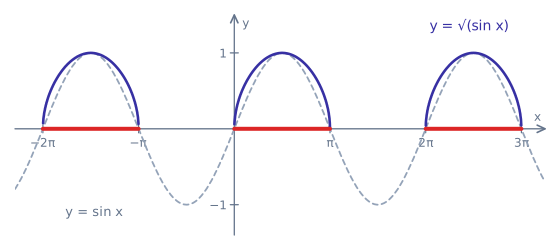
Example. For , (just substitute; in radians).
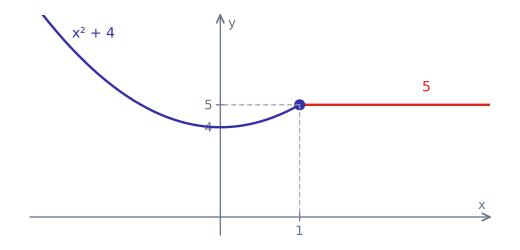
Example. Let If has a limit at , what values can take?
The two one-sided limits must be equal: For example, for , for and for .
The Formal Definition of a Limit
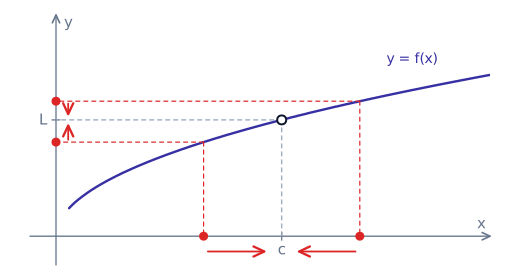
Definition (Epsilon-delta definition). means: for every there is a such that
and are small distances. However small an we are given, we must find a such that every within of (except itself) has within of . In the picture: the horizontal band is given; we must find a vertical band such that the piece of the graph inside the vertical band stays inside the horizontal band.
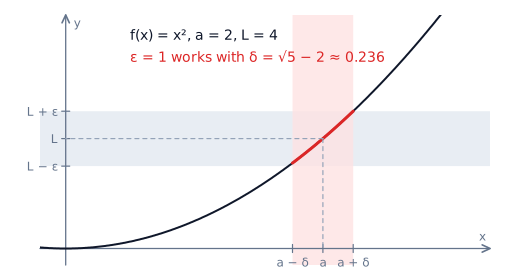
Here means ; the distance from to the nearer end is . Any larger fails. Try it yourself with the epsilon-delta tool.
Infinite Limits
Definition. becomes infinite as approaches if can be made arbitrarily large (positive or negative) by taking close enough to . We write The same definition works for one-sided limits and .
Since is not a number, the limit does not exist in these cases; writing says how it fails to exist.
Example. . Some investigation: So and ; the one-sided limits are different, and does not exist (we cannot even write ).
Remark. A nonzero number divided by something that goes to goes to . The sign follows the usual rules: Here means "approaching through positive values" and "through negative values".
Examples.
- : check the one-sided limits. and . Hence the limit does not exist.
- : from both sides , so both one-sided limits are . The limit still does not exist, but we can write .
- : is negative to the left of and positive to the right, and so is its cube. So and .
- near : .
- : as , and , so the limit is ; as it is .
- : the numerator goes to , and from both sides (since ). So both one-sided limits are .
- : the numerator goes to . From the left , giving ; from the right , giving .
- : the numerator goes to . For , , so and : the limit is . For it is .
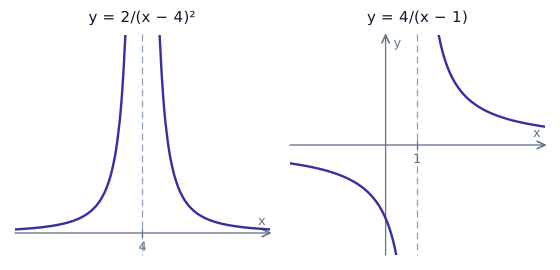
Tip. If you can see that the limit is infinite but are not sure of the sign, use your calculator (in radians): compute at a value very close to , once from the left and once from the right.
Limits at Infinity
Definition. We write if the difference between and can be made arbitrarily small by making sufficiently large positive (or negative).
Example. : , , , so , and likewise . In general,
Example. : . The line is a horizontal asymptote.
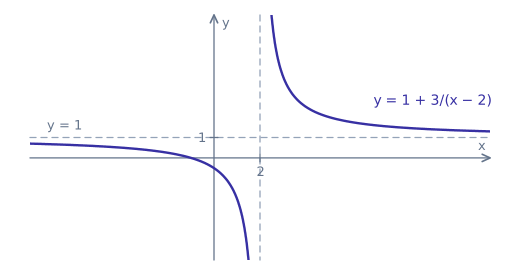
Infinite limits at infinity. If becomes infinite as becomes infinite, we write or . For example
Limits of Polynomials and Rational Functions
A polynomial is , of degree if , and a rational function is with polynomials and .
Theorem. For any polynomial and any number ,
Limit Laws
The theorem above follows from a few rules that let us split a complicated limit into simple ones.
Theorem (Limit laws). Suppose and , where and are numbers. Then
- ,
- for every constant ,
- ,
- , provided ,
- and (for even we need ).
The same laws hold for one-sided limits and for limits as .
Since and , laws 1–3 and 5 give for every polynomial, and law 4 gives the same for rational functions:
Example. The denominator is not at , so we simply substitute.
Evaluating Limits Algebraically
The quotient law needs . When we substitute and get
- a number: that is the limit;
- : the limit is infinite (or does not exist); check the two one-sided limits with the sign rules of the remark above;
- : this is an indeterminate form. It tells us nothing yet: the limit may be any number, infinite, or may not exist. We have to rewrite the expression first.
The rewriting always uses the same idea: for the expression equals a simpler one, and since the limit never uses the value at , the two have the same limit. The common tricks are factoring, multiplying by the conjugate, and combining fractions.
Remark (Choosing a method (AP)).
- Substitute. If you get a number, you are done.
- Nonzero over zero: look at the signs from the left and from the right.
- with polynomials: factor and cancel.
- with square roots: multiply by the conjugate.
- with fractions inside a fraction: combine them over a common denominator.
- with : use (below).
- with a rational function: compare the degrees (below).
Factoring
Example.
Example. Here we use the sum of cubes, (and the difference of cubes ):
Example. Cancelling can also leave a nonzero number over zero: because . With one more power the signs differ:
Example. . The function is not defined at , but everywhere else it equals , so its limit at is .
Example. (This kind of limit will define the derivative.)
Combining Fractions
Example.
Multiplying by the Conjugate
The conjugate of is , and their product has no square roots: .
Example.
Example.
Example. In the same way (the square root is now in the denominator),
Limits at Infinity of Rational Functions
Let so and . For example, has and , and has and .
Method. Factor out the highest power of from the numerator and from the denominator. Every term () then goes to , because
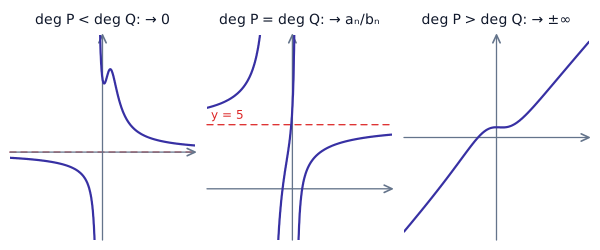
Case I: . Then . Another example: .
Case II: . Then (the limit does not exist; is not a number). The sign is the sign of for large . In the second one the leading terms give ; in the third, .
Case III: . Then the limit is the ratio of the leading coefficients: .
Definition. The line is a horizontal asymptote of the graph of if or . The line is a vertical asymptote if at least one of the one-sided limits , is or .
So in Case III the graph has the horizontal asymptote , in Case I the asymptote , and in Case II none.
Square roots at (a common AP trap). , and for this is , not . This graph has two different horizontal asymptotes, and .
The Squeeze Theorem
Theorem (Squeeze theorem (sandwich theorem)). If for all near (except possibly at ), and then . The same holds for .
is trapped between two functions that go to the same place, so it has to go there too.
Example. . Since , for The same argument works for .
Example. . We cannot use the product law, because does not exist (it oscillates). But , and both sides go to .
Some Basic Limits
These limits come up again and again (and will give the derivatives of , and ).
1. The limit of at .
Theorem.
Proof. Take and compare three areas in the unit circle: the triangle , the sector and the triangle , where is on the tangent line at .
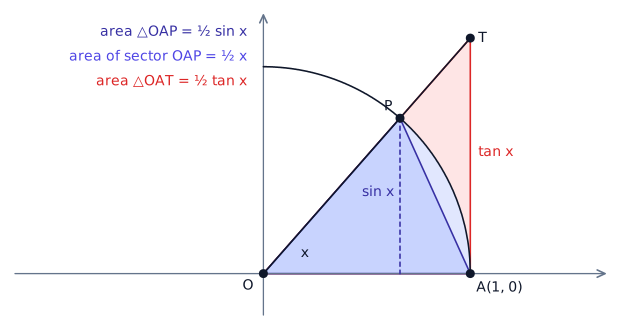
The triangle has base and height ; the sector has angle in a circle of radius , so its area is ; the triangle has base and height . Hence Divide by : , and take reciprocals (which reverses the inequalities): As , , so by the squeeze theorem . For nothing changes, because .
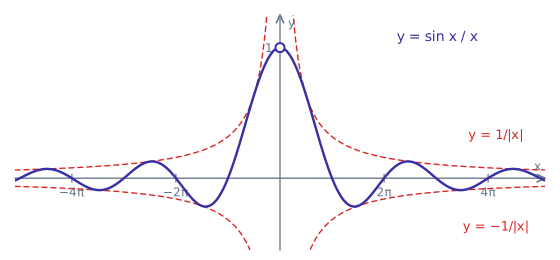
Examples. The trick is to make the argument of and the denominator equal.
- : put ; , so .
- .
- .
- .
- . Multiply by :
2. The limit of at is , by the squeeze theorem (the first example above).
3. The number .
Theorem.
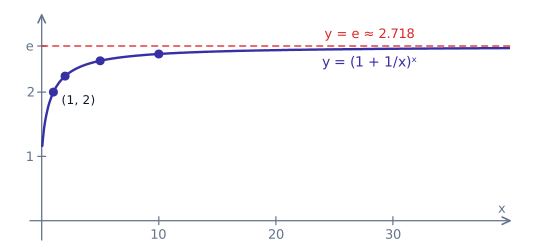
This is a form: the base goes to , the exponent to . Such a limit is not automatically . Some consequences:
- .
- .
- .
- More generally, , and (put ).
Quiz 5: Limits
15 multiple-choice questions on limits. No calculator unless a question says so. Suggested time: 30 minutes.
1. What is ?
- (A)
- (B)
- (C)
- (D) It does not exist.
For questions 2 and 3, let
2. What is ?
- (A)
- (B)
- (C)
- (D) It does not exist.
3. What is ?
- (A)
- (B)
- (C)
- (D) It does not exist.
4. Let be the greatest integer less than or equal to . Which statement is true?
- (A)
- (B) and
- (C)
- (D) has a limit at every integer.
5. What is ?
- (A)
- (B)
- (C)
- (D)
6. Let For which values of does exist?
- (A) only
- (B)
- (C)
- (D)
7. What is ?
- (A)
- (B)
- (C)
- (D)
8. What is ?
- (A)
- (B)
- (C)
- (D)
9. What is ?
- (A)
- (B)
- (C)
- (D)
10. What is ?
- (A)
- (B)
- (C)
- (D)
11. What is ?
- (A)
- (B)
- (C)
- (D)
12. What is ?
- (A)
- (B)
- (C)
- (D)
13. For we have . For , what is the largest such that implies ?
- (A)
- (B)
- (C)
- (D)
14. Which interval is contained in the domain of ?
- (A)
- (B)
- (C)
- (D)
15. What is ?
- (A)
- (B)
- (C)
- (D) It does not exist.
Answer key
| Question | Answer | Why |
|---|---|---|
| 1 | B | Cancel : the limit of at . |
| 2 | C | From the left we use : . |
| 3 | D | The left limit is and the right limit is . |
| 4 | B | Just left of , ; just right of , . |
| 5 | A | The greatest integer that is is , not . |
| 6 | C | . |
| 7 | B | . |
| 8 | A | from both sides. |
| 9 | D | , so . |
| 10 | C | The numerator goes to and from both sides. |
| 11 | D | . |
| 12 | A | For large negative , is large negative, so is large positive. |
| 13 | C | exactly when . |
| 14 | B | on . |
| 15 | A | For a polynomial, substitute: . |
Continuity
If a function is continuous on an interval, we can draw its graph there without lifting the pencil from the paper: the graph has no holes, breaks or jumps. Conceptually, if is continuous at , then the closer is to , the closer is to . The following definition makes this precise.
Continuity at a Point
Definition. The function is continuous at if
- exists, that is, is in the domain of ( must be a number);
- exists;
- .
A function that is not continuous at is discontinuous there, and is called a point of discontinuity.
The three conditions are all hidden in one equation: On the AP exam, a justification of continuity has to check all three, for example: ", , so and is continuous at ."
Definition. is continuous on the closed interval if it is continuous at every with , and at the endpoints it is continuous from inside the interval:
Continuous Functions
- Polynomials are continuous everywhere, at every real number: is defined for every and .
- Rational functions are continuous everywhere they are defined, that is, at every with .
- is continuous at every point.
- Trigonometric, inverse trigonometric, exponential and logarithmic functions are continuous at every point where they are defined.
- ( an integer) is continuous at every point where it is defined.
- Sums, differences, products and constant multiples of continuous functions are continuous, and so are quotients where the denominator is not (by the limit laws).
- If is continuous at and is continuous at , then is continuous at . In particular we can move a limit inside a continuous function:
- The greatest integer function is continuous at every point except the integers. For example , so does not exist: the left-hand and right-hand limits are different.
Kinds of Discontinuities
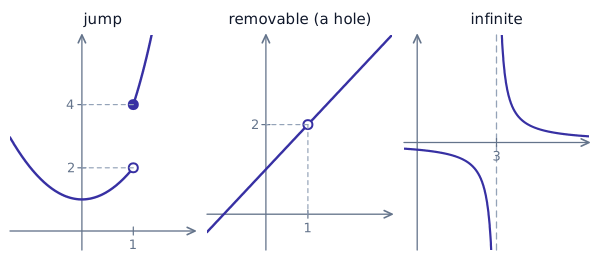
1. Jump discontinuity. Both one-sided limits exist at , but they are different:
Example. Here and , so has a jump at .
Example. has a jump discontinuity at every integer.
2. Removable discontinuity. exists, but is not defined or . The graph has a hole, and we can “remove” the discontinuity by defining (or redefining) as the limit.
Example. : is not defined, but The function is continuous at , since . (In fact for every .)
3. Infinite discontinuity. At least one of the one-sided limits is infinite: The line is then a vertical asymptote.
Example. has infinite discontinuities where . At the numerator is , and from the right and from the left, so The same happens at .
Remark. The jump and the infinite discontinuity cannot be removed: no choice of makes the limit exist.
Examples
Example. Discuss the continuity of the function of the worked example in the limits section,
- On each open piece is a polynomial, so it is continuous there.
- : . Jump discontinuity.
- : , but . Removable discontinuity (redefine ).
- : , so is continuous from the left at the endpoint .
- is not in the domain, so we do not ask about continuity there.
Example. is not continuous at , because is not defined (the same for : is not defined). Both are infinite discontinuities: at the numerator goes to and the denominator to .
Example. Discuss the continuity of the function in the figure.
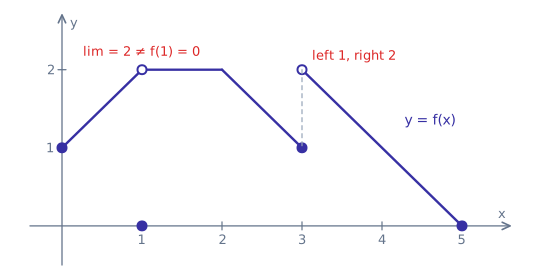
- : exists, but . Not continuous: a removable discontinuity.
- : and , so does not exist. Not continuous: a jump.
- At the corner the graph changes direction but does not break, so is continuous there. It is continuous at every other point of too.
Example. Is continuous at ? Yes: is a polynomial, and polynomials are continuous at every real number.
Example. Is continuous (a) at , (b) at ?
- (a) No. is not defined, and , : an infinite discontinuity.
- (b) Yes. is a rational function and its denominator is not at : .
Making a Piecewise Function Continuous
A typical AP question gives a piecewise function with an unknown constant and asks for the value that makes it continuous. On each piece the function is a polynomial, so the only point to check is where the formula changes; there the two one-sided limits and the value must agree.
Example. For which is continuous everywhere? Continuity at needs , so and . (Compare the earlier example where and met at : there .)
The Intermediate Value Theorem
Theorem (Intermediate Value Theorem (IVT)). If is continuous on the closed interval and is any number between and , then there is at least one number in with .
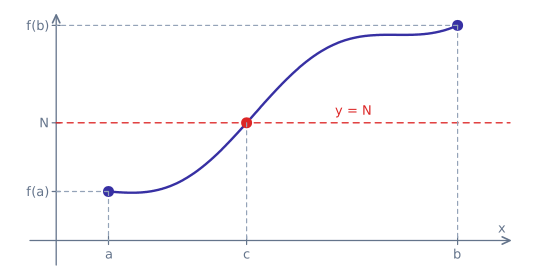
The theorem says that such a exists, not where it is, and there may be several. Continuity on the whole closed interval is essential: has and , but it never takes the value , because it is not continuous at .
Example. Show that has a solution between and .
Let . It is a polynomial, so it is continuous on . Since and , the value lies between and , and by the Intermediate Value Theorem there is a in with .
Example (AP style). is continuous on with , and . Then has at least two solutions in : one in , where goes from to , and one in , where it goes from to .
Quiz 6: Limit Techniques and Continuity
15 multiple-choice questions on algebraic limits, limits at infinity, the basic limits, continuity and the Intermediate Value Theorem. No calculator. Suggested time: 30 minutes.
1. What is ?
- (A)
- (B)
- (C)
- (D) It does not exist.
2. What is ?
- (A)
- (B)
- (C)
- (D)
3. What is ?
- (A)
- (B)
- (C)
- (D) It does not exist.
4. What is ?
- (A)
- (B)
- (C)
- (D)
5. What is ?
- (A)
- (B)
- (C)
- (D)
6. What is ?
- (A)
- (B)
- (C)
- (D)
7. What is ?
- (A)
- (B)
- (C)
- (D)
8. What is ?
- (A)
- (B)
- (C)
- (D)
9. What is ?
- (A)
- (B)
- (C)
- (D)
10. What is ?
- (A)
- (B)
- (C) It does not exist, because oscillates.
- (D)
11. What is ?
- (A)
- (B)
- (C)
- (D)
12. Which statement about at is true?
- (A) It has a removable discontinuity, and .
- (B) It has a jump discontinuity.
- (C) It has an infinite discontinuity.
- (D) It is continuous at .
13. Let Which statement about at is true?
- (A) is continuous at .
- (B) has a removable discontinuity at .
- (C) has an infinite discontinuity at .
- (D) has a jump discontinuity at .
14. For which value of is continuous for all real numbers?
- (A)
- (B)
- (C)
- (D)
15. is continuous on , and . Which statement must be true?
- (A) is increasing on .
- (B) for some in .
- (C) .
- (D) for some in .
Answer key
| Question | Answer | Why |
|---|---|---|
| 1 | A | . |
| 2 | C | , and . |
| 3 | B | Multiply by the conjugate: . |
| 4 | D | , so the quotient is . |
| 5 | A | , so the limit is . |
| 6 | C | Equal degrees: . |
| 7 | B | The leading terms give , which is large positive when . |
| 8 | C | For , , so the limit is . |
| 9 | D | . |
| 10 | B | Squeeze: . The limit of is not needed. |
| 11 | C | . |
| 12 | A | is not defined, but for . |
| 13 | D | The left limit is and the right limit is . |
| 14 | A | . |
| 15 | B | is between and (IVT). is not between them, and nothing is known about increasing. |
Flashcards
One card for every definition in these notes. Tap or click a card (or press the space bar) to see the definition; use the arrows to move between cards.
Rational number
A number of the form with and . Its decimal expansion ends or repeats.
Irrational number
A real number that is not rational, such as or . Its decimal expansion is infinite and does not repeat.
Real numbers
The smallest number system that contains and has no gaps.
Open and closed intervals
is , endpoints excluded; is , endpoints included. and are half-open.
Absolute value
if and if : the distance from to . is the distance between and .
Discriminant
For , . Two real roots if , one double root if , none if .
Slope of a line
, where is the angle with the positive -axis.
Point-slope form
The line through with slope : .
Perpendicular lines
Lines with slopes and are perpendicular when .
Equation of a circle
: centre , radius .
Function
A rule that assigns a unique element of to each element of the domain .
Domain and range
The domain is the set of inputs ; the range is the set of all values .
Domain convention
If only the rule is given, the domain is all real for which is a real number (the maximal domain).
Equal functions
Two functions are equal if they have the same rule and the same domain.
Composite function
, defined for in the domain of with in the domain of .
Polynomial and its degree
with ; is the degree.
Rational function
with polynomials , ; its domain is all with .
Root of a polynomial
A number with . By the factor theorem, is a root if and only if divides .
Multiplicity of a root
has multiplicity if divides but does not. The sign changes at roots of odd multiplicity only.
Radian
radians, so radians degrees .
and on the unit circle
The point at angle (counterclockwise from the positive -axis) on is .
Even and odd functions
is even if (like ) and odd if (like ).
Exponential function
with , defined for all real ; increasing if , decreasing if .
Logarithm
For , : . Domain .
Natural logarithm
with ; and .
One-to-one function
; every horizontal line meets the graph at most once.
Inverse function
For one-to-one : . Its graph is the graph of reflected in .
(arcsin)
and . Domain , range .
(arccos)
. Domain , range .
Limit
As gets arbitrarily close to (but ), gets arbitrarily close to .
One-sided limits
uses , uses . The limit exists exactly when both exist and are equal.
Greatest integer function
The greatest integer less than or equal to ; for example and .
Epsilon-delta definition of a limit
For every there is a such that implies .
Infinite limit
if becomes arbitrarily large (positive or negative) as . The limit then does not exist.
Limit at infinity
if gets arbitrarily close to for sufficiently large ; for example .
Indeterminate form
Substituting gives : the limit is not yet known. Rewrite the expression (factor, multiply by the conjugate, combine fractions) before substituting again.
Horizontal asymptote
The line with or .
Vertical asymptote
The line where at least one one-sided limit of at is or .
Continuous at
exists, exists, and .
Continuous on
Continuous at every point of , with and .
Jump discontinuity
Both one-sided limits at exist but are different, so does not exist.
Removable discontinuity
exists, but is undefined or different from it; defining as the limit removes it.
Infinite discontinuity
At least one one-sided limit at is ; the line is a vertical asymptote.